

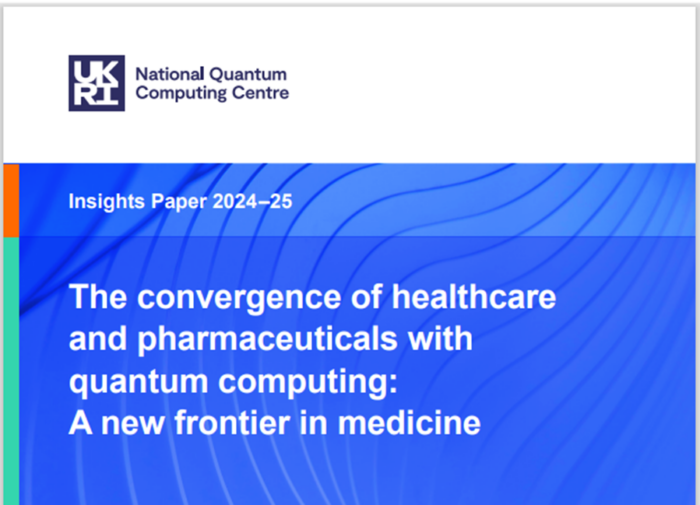
A little over a year ago, in March 2025, the NQCC published its inaugural Insights Paper, The Convergence of Healthcare and Pharmaceuticals with Quantum Computing. It drew together the discussions from our first Quantum Computing in Healthcare and Pharma (QCHP) workshop at the Royal Society, alongside sectoral consultations, expert interviews, and a global literature review, to map the earliest explorations of quantum computing in healthcare and pharma.
The question for the sector up to March 2025 was a simple one: could quantum computing deliver something genuinely useful for human health, on real hardware, against a real biological problem?
The Insights Paper identified more than 40 proof-of-concept projects in the literature, spanning everything from small-molecule electronic-structure calculations to early explorations of molecular properties and binding, identifying the groundbreaking potential of quantum computing in genomics, drug discovery, and healthcare optimisation. At the time, the status of the field was genuinely early-stage, with most work confined to quantum chemistry or toy problems and few, if any, results on biologically meaningful systems at scale.

A year on, that answer is changing. The pre-competitive scepticism that defined early 2025 has begun to give way to experimental results on real quantum hardware.
Results from the finalists and winners of the Wellcome Leap’s Quantum for Bio (Q4Bio) challenge have been encouraging. For the first time, a team has reported the development of an end-to-end quantum-classical workflow that simulated clinically relevant therapeutics on real quantum hardware, up to 100 qubits. Algorithmiq’s winning framework focused on photodynamic therapy for cancer treatment, a domain where molecular simulation complexity quickly outstrips classical computing capacity. The team, together with IBM and the Cleveland Clinic, built software that bridges current quantum limitations with real-world pharmaceutical applications, combining quantum and classical methods in a way that neither could achieve alone. In the same Q4Bio programme, the University of Oxford and the Wellcome Sanger Institute report having encoded the complete hepatitis-D genome onto a quantum computer using 117 qubits – a world first for genomics on quantum hardware. This is because the structure of many computational-genomics problems makes them suitable candidates for the speedups that quantum algorithms promise.
A separate Cleveland Clinic-IBM collaboration, working with RIKEN, modelled the 303-atom
Trp-cage mini-protein and then, within months, scaled to far larger protein-ligand systems:
T4-lysozyme and trypsin, capturing more than 12,000 atoms in a realistic solution.
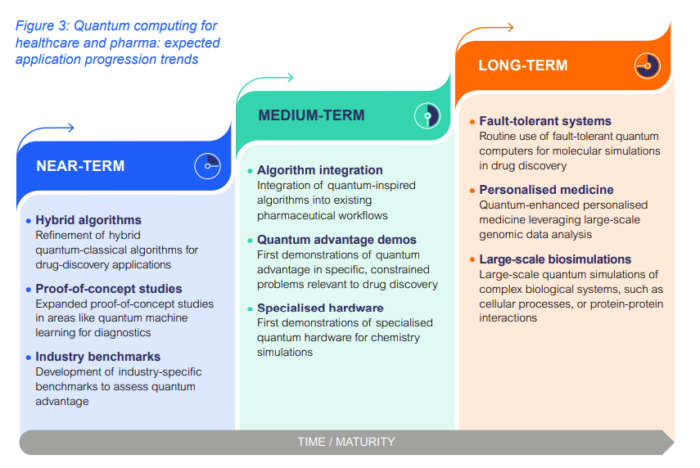
What unites these results is architecture. Each is an example of hybrid, quantum-centric supercomputing (QCSC): quantum processors handle the hardest fragments of a problem while classical high-performance computing does the rest. That is precisely the near-term path the Insights Paper anticipated (see figure below), and it is why the scaling barriers that held back complex biological simulation are beginning to move.
While these results are still very early stage and most await rigorous peer review, taken together, they begin to map where quantum may add value over classical methods: highly entangled and excited-state problems, and the data-loading challenges that have long sat at the heart of quantum chemistry and genomics.
Where chemistry’s advantage is “the system is quantum,” genomics’ advantage is “the search space is astronomically large and structured”.
The direction of travel is unmistakable, and it’s great to see UK teams driving it at the forefront, with teams from Oxford, Sanger Institute, and Nottingham being among the global finalists.
These collaborative international efforts have effectively changed the sector’s central question. We are shifting from asking whether quantum can help, to asking which clinically and commercially meaningful problems at the limits of our conventional computing methods it should be aimed at first.
This shift arrives alongside real national commitment. Quantum for healthcare sits within the UK’s Modern Industrial Strategy at the meeting point of two of its eight growth-driving sectors – Life Sciences and Digital & Technologies, where quantum is a named frontier technology, backed by the £2 billion of government investment. Through ProQure, the UK’s new quantum procurement programme, the government is developing a pathway to procure quantum capability and not only fund research: a signal of demand that helps pull innovation towards real-world use. Alongside world-leading biomedical sensing capabilities, and a maturing applications ecosystem anchored at Harwell, the UK is well placed to lead the next phase of this conversation.
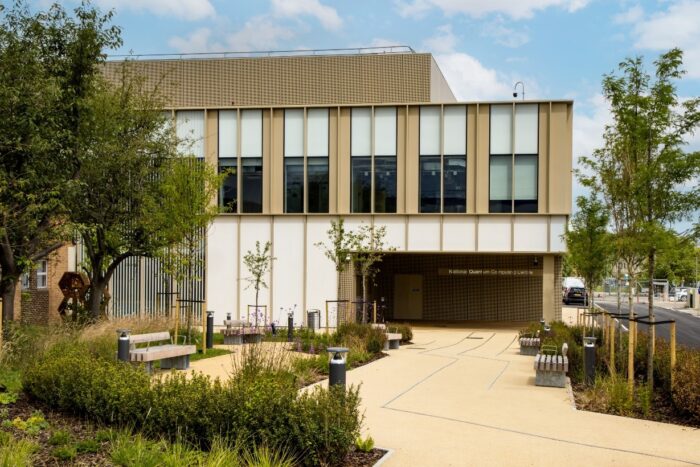
The NQCC is the UK’s national quantum computing laboratory. As part of its quantum readiness mandate, and as a trusted authority, the NQCC helps bring researchers, industry, the NHS, regulators and funders into the same conversation supporting the work of identifying which biological problems are realistic near-term priorities. The NQCC helps to broker access to quantum hardware, both sovereign and commercial, through SparQ, our proof-of-concept calls, and initiatives such as our recent collaboration with Google Quantum AI to make the Willow processor available to UK researchers. The aim throughout is to translate early results into genuine, well-evidenced, and practical sector readiness, driving economic and societal benefits.
Considering the feedback received from the ecosystem across 2024 and 2025, and following the recommendations of the Insights Paper, the NQCC has recently opened its next round of proof-of-concept funding, with a particular focus on healthcare. Recognising the need to nurture early-stage work while building the scaffolding towards larger, longer-term projects, this round also introduces a POC+ stream. Alongside this, a BBSRC-STFC facilities-access route for bioscience partnerships is helping to channel the energy and diverse expertise of the Harwell campus into the same ambition, and we eagerly await the results of these collaborations. Over the coming months, we will reopen this conversation as the next phase of the NQCC’s engagement in this sector gets underway through workshops, networking sessions, and a national seminar series drawing in and engaging diverse stakeholders.
If you work in quantum, in the life sciences/healthcare/pharma sectors, or at the boundary between them, feel free to reach out to us through our various channels! We would love to hear from you.
Download the Insights Paper here: The Convergence of Healthcare and Pharmaceuticals with Quantum Computing.
Sources / Further reading
The scientific results described above are early-stage and, except where noted, await full peer review; the references below point to the originating institutions and, where available, to the primary preprints and papers.
- Photodynamic therapy on up to 100 qubits (Algorithmiq, IBM, Cleveland Clinic). IBM Quantum, “How IBM Quantum is enabling healthcare and biology research”; Algorithmiq, “Algorithmiq wins $2 million Wellcome Leap prize”.
- Complete hepatitis-D genome encoded on 117 qubits (Oxford, Wellcome Sanger Institute, and partners). Wellcome Sanger Institute, “Genome loaded onto a quantum computer in world first”; University of Oxford, “Oxford researchers contribute to world-first in quantum computing and genomics”. (The wider collaboration also includes Cambridge, Melbourne, and Kyiv Academic University.)
- 12,635-atom protein–ligand simulation (Cleveland Clinic, RIKEN, IBM). IBM Quantum, “Quantum-centric supercomputing simulates 12,635-atom protein” .
- Quantum-enhanced covalent inhibitor design (University of Nottingham, Phasecraft, QuEra). Hirst et al., “Challenges and Advances in the Simulation of Targeted Covalent Inhibitors Using Quantum Computing,” J. Phys. Chem. Lett. 2025, 16, 8536–8545 (open-access version);
- Q4Bio milestone summarised in IBM Quantum, “Q4Bio finalists”.
- ProQure and the £2 billion quantum commitment. DSIT / GOV.UK announcement, 17 March 2026 (link the official press release); NQCC, “The UK has thrown down the gauntlet on quantum”.
- Willow processor access for UK researchers. NQCC, “NQCC and Google Quantum AI launch new initiative to accelerate quantum science in the UK”.
- NQCC Insights Paper. The Convergence of Healthcare and Pharmaceuticals with Quantum Computing (already linked in the body).