

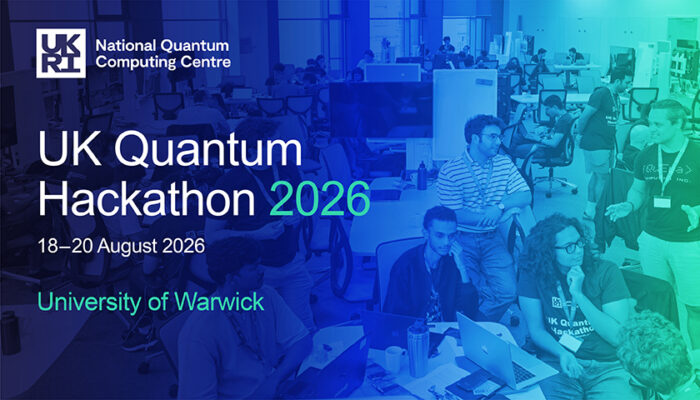
The UK Quantum Hackathon, now entering its fifth consecutive year, is an important initiative within the National Quantum Computing Centre’s (NQCC) SparQ programme, the NQCC’s flagship user-engagement programme. The 2026 Hackathon will take place at the University of Warwick from 18–20 August, bringing together students, early-career researchers and industry mentors to work collaboratively on real-world challenges using quantum computing.
The UK Quantum Hackathon is more than a technical coding competition. It forms part of the UK’s broader efforts to develop the skills, applications, users and collaborative networks required to build a quantum-ready economy. Through hands-on experience with quantum algorithms and real quantum computing platforms, participants develop practical capabilities that are difficult to acquire through classroom-based learning alone. At the same time, industry and other end-users have an opportunity to explore how quantum computing could address real-world challenges and to understand the technology’s current capabilities and limitations.
This activity aligns closely with the objectives of establishing the UK as a world-leading quantum-enabled economy. The UK’s Quantum Mission 1 focuses on quantum computing and sets an ambitious target: by 2035, the UK will have accessible, UK-based quantum computers capable of performing one trillion operations and supporting applications that deliver benefits well in excess of those of classical supercomputers across key sectors of the economy. Importantly, Mission 1 is not simply a target to build a more powerful quantum computer, but also to develop competitive UK capabilities in quantum hardware, control architecture and the supply chain; develop the algorithms and software needed to perform valuable calculations on quantum computers; and integrate quantum computing into high-performance computing workflows so that users across the UK can access and adopt the technology.
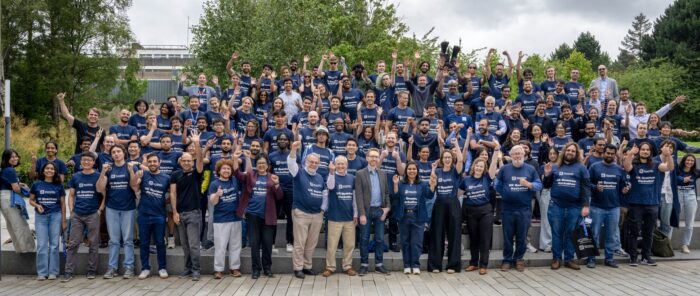
The UK Quantum Hackathon contributes to these wider objectives by addressing the people and applications side of the quantum computing challenge.
First, it helps build the quantum skills pipeline. Mission 1 will ultimately depend on a workforce capable of developing, programming, operating and using increasingly sophisticated quantum computers. This requires not only quantum physicists and hardware engineers, but also software developers, algorithm specialists, mathematicians, data scientists, engineers and domain experts who understand how quantum computing can be applied to practical problems. The NQCC’s SparQ programme explicitly identifies skills development as one of its core pillars and aims to support the development of the current and future quantum workforce and address the STEM skills gap.
Second, the Hackathon supports application and use-case discovery. Building a capable quantum computer is only one part of achieving quantum advantage. The UK will also need to identify problems for which quantum computing can deliver meaningful benefits, map and formulate real-world challenges into problems suitable for quantum approaches, and develop the algorithms and software required to solve them. This problem formulation and mapping is a key part of the quantum software development pipeline, helping to translate industry needs into well-defined computational problems that can be addressed using quantum algorithms. The Hackathon puts this principle into practice by asking teams to work on real-world industry challenges, with the 2026 event highlighting areas including healthcare, energy and engineering.
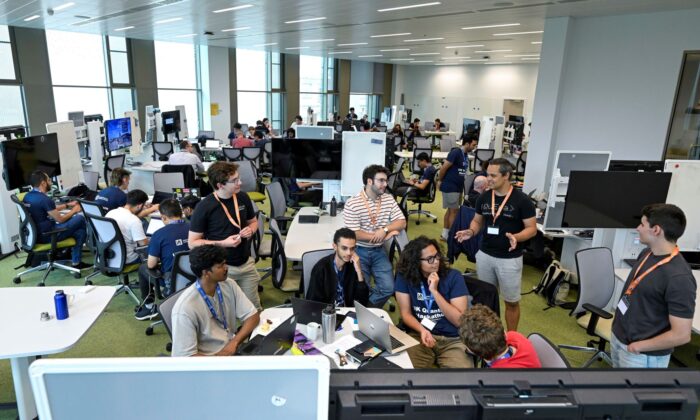
This focus on applications directly reflects Mission 1’s emphasis on achieving useful computational outcomes rather than simply demonstrating technological performance. Healthcare, finance, transport, defence, energy and manufacturing are some of the key sectors in which high-impact quantum applications should ultimately be achieved. Previous Hackathons illustrate this sector-focused approach: the 2024 event, for example, included challenges involving insurance risk, communications networks and NHS forecasting.
Third, the Hackathon helps build the UK quantum computing user community. SparQ is designed to connect quantum software developers, technology providers and end users, facilitating knowledge exchange and accelerating adoption in both the public and private sectors. The Hackathon brings these groups together in a practical environment, allowing participants to work with industry mentors and quantum technology providers while gaining experience of the current generation of quantum hardware and software.
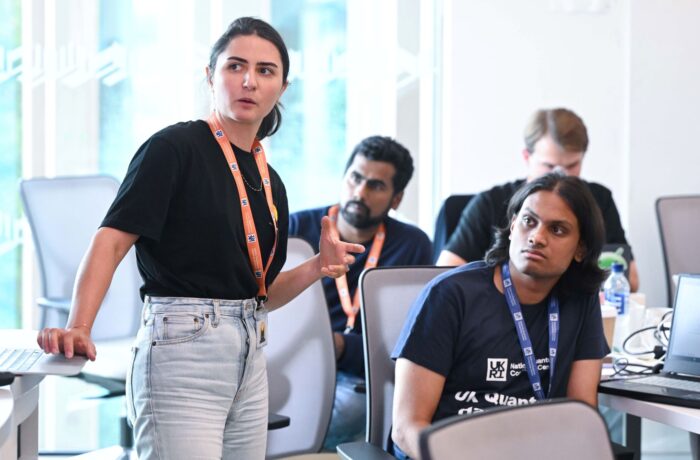
This ecosystem-building function is particularly important because the transition to useful quantum computing will require collaboration across disciplines and organisations. Platform and service providers need to understand the requirements and challenges facing end users; applications and algorithm developers benefit from access to platforms; and businesses and public-sector organisations need the expertise to identify where quantum computing might eventually provide value. Initiatives such as the UK Quantum Hackathon help create these connections at an early stage.
The Hackathon therefore supports a broader concept of ‘quantum readiness’. SparQ was established as a mechanism for developing this readiness through activities including skills development, application discovery, access to quantum computing resources, networking, hackathons and collaborative R&D.
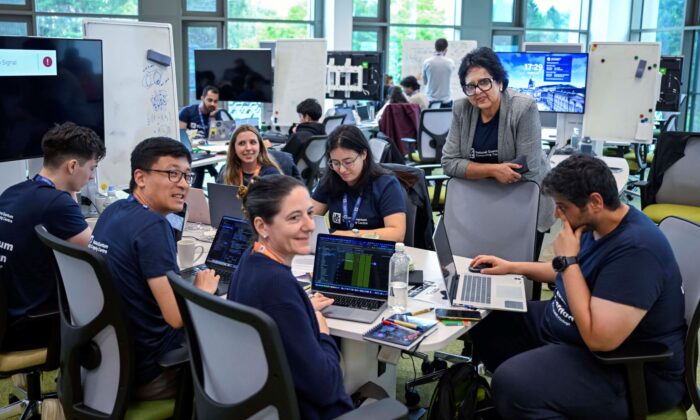
At the NQCC, we work proactively to embed responsible and ethical quantum computing (REQC) throughout all of our activities, underpinned by our Quantum STATES principles, as well as championing and enabling a responsible approach across the quantum landscape. The NQCC’s annual Quantum Hackathon incorporates REQC as a core component, training a new generation of quantum computing researchers to consider and address societal and ethical considerations and to innovate responsibly.
There is also an important progression from skills development to innovation and commercialisation. The Hackathon gives participants an initial opportunity to experiment with quantum algorithms and hardware and explore potential applications. Where promising ideas emerge, the wider SparQ ecosystem provides routes towards further development, including access to quantum computing resources, proof-of-concept and collaborative R&D opportunities. In this way, the Hackathon acts as an entry point into a broader innovation pathway rather than being an isolated event.
Five years of the UK Quantum Hackathon demonstrate the NQCC’s continuity and sustained investment in the UK’s quantum talent and user ecosystem. The development of a quantum-ready economy will take place over many years, alongside advances in hardware, error correction, control systems and quantum software. Building the skills and communities that can make effective use of these technologies must happen in parallel. The UK Quantum Hackathon helps create some of the critical conditions required for that target to translate into economic and societal value.
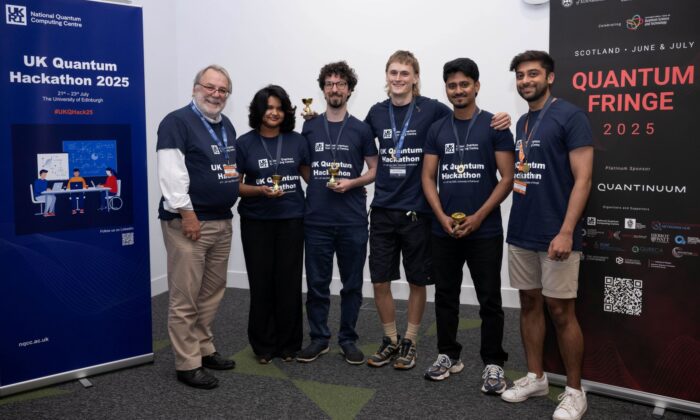
In this sense, the Hackathon addresses a fundamental question: when increasingly capable quantum computers become available, will the UK have the people, expertise, applications and organisations ready to use them?
By developing practical quantum computing skills, encouraging application discovery, connecting emerging talent with industry and technology providers, and strengthening the UK’s quantum user community, the UK Quantum Hackathon is helping to ensure that the answer is yes.
A huge shout-out to the team, led by Daisy Shearer, Quantum Computing Outreach and Education Lead at the NQCC, for delivering this high-impact event year after year. Can’t wait to see the outcomes of the 2026 Hackathon!
Visit the UK Quantum Hackathon 2026 website at https://www.nqcc.ac.uk/uk-quantum-hackathon-2026/.