



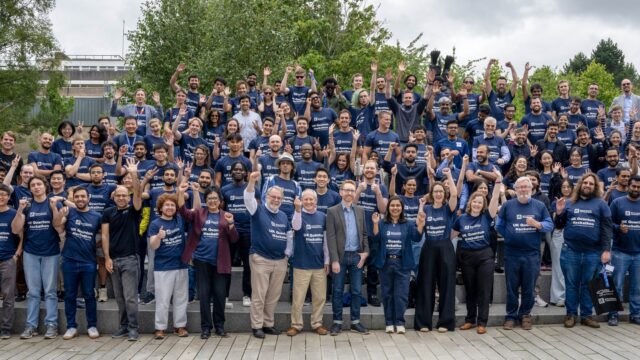
Training cohorts of future leaders in quantum computing
The NQCC’s Doctoral Studentship Scheme provides a unique training experience. It combines access to the NQCC’s state-of-the-art facilities and expertise across the technology stack with the academic excellence of world-class UK universities.
The scheme is designed for cohorts of six students to start each year from autumn 2025 to autumn 2029. The studentships are fully funded through the EPSRC’s Industrial Doctoral Landscape Awards (IDLA). Studentship projects are co-developed by the NQCC and academic institutes across the UK through our application process. Students will be based at the host university, with an expert co-supervisor at the NQCC. Over the course of the studentship students will have the opportunity to spend at least three months at the NQCC to work with relevant research teams.
Through cohort-based training and activities, the scheme will equip students with broader skills – for example, in public engagement and responsible innovation and support the development of strong personal and professional networks.
Apply hereApplying for funding
Academics at UK universities can apply for a studentship through our two-stage application process: In early June the NQCC invites short summaries of proposed projects via an Expressions of Interest (EOI) call. In early August shortlisted EOIs are invited to develop full proposals with an NQCC co-supervisor. Full proposals are reviewed by relevant members of the NQCC doctoral studentship review board and the successful applicants are notified by November 2026.
EOI for studentships: Opens 9th June 2026, closes 14th July 2026
EOI shortlisting: Late July 2026
Full project proposals: Invitations by early August, closes 27th September 2026
Review board shortlisting: By mid October 2026
EPSRC review: Late October 2026
Announcement of Results: November 2026
Research areas
The NQCC funds studentships across quantum computing hardware, software, applications and component technologies. Studentships will sit within one of the following technical teams:
- Trapped Ion Quantum Computing
- Superconducting Circuits Quantum Computing
- Tweezer Array Quantum Computing
- Quantum Computing Applications
- Quantum Computing Software and Control Systems
Priority themes are updated every year and outlined in our application process.
Funding available
Each year the NQCC will receive 6 EPSRC Industrial Doctoral Landscape Awards vouchers, to be awarded to successful academic partners. The EPSRC IDLA studentships are funded for 4 years starting every autumn, covering fees, stipend and the Research Training Support Grant (RTSG). The RTSG covers budget for consumables, equipment and travel. Please see training grant terms and conditions and specific IDLA terms and conditions for further information. Any estates or indirect costs must be covered by the university.
All financial contributions will be covered by the EPSRC IDLA grant i.e. universities will receive funding directly from the ESPRC and no separate contributions will be made by the NQCC. The student will need to be registered at the host university. The NQCC will set up an agreement with the host university to outline how we will collaborate, ownership of intellectual property and any other details of the working arrangements for the studentship.
Eligibility criteria
NQCC doctoral studentships will be co-supervised by a UK university academic and a staff member with relevant expertise from one of the NQCC’s technical teams. Any academic belonging to UK universities with the authorisation to supervise PhD students may apply as the university supervisor.
NQCC studentships are open to home students only. To be treated as a home student, candidates must meet one of these criteria:
- be a UK national (meeting residency requirements)
- have settled status
- have pre-settled status (meeting residency requirements)
- have indefinite leave to remain or enter.
The student should spend a minimum of 3 months of their time at the NQCC during their PhD, in a schedule to be arranged by mutual agreement between the NQCC and university supervisors. However, the exact length of time the student spends at the NQCC will be agreed by the NQCC and university supervisors prior to recruitment.
Due to the potential nature of projects the successful candidate will be required to successfully complete national pre-employment control checks to the BPSS (Baseline Personnel Security Standard) to fulfil the role. BPSS checks typically take between 3-4 weeks but may take longer Government baseline personnel security standard – GOV.UK (www.gov.uk). Offers are conditional upon candidates passing the BPSS checks.

Skills development provides pathways into quantum workforce
Skills development and training are crucial priorities for the NQCC…