

Modular Quantum-Noise Limited Amplifier Arrays for Scaling up Superconducting Qubit Platform
University: University of Oxford
Microwave quantum-limited amplifiers (QLAs) operate at the fundamental noise limit set by quantum mechanics. They have played a pivotal role in achieving readout fidelities above 99% for single- and two-qubit gates in superconducting quantum computing (QC) platforms, and ultra-sensitive fundamental physics experiments such as astronomy, dark matter search and neutrino mass determination efforts. These advances have enabled major milestones such as the first demonstrations of quantum error correction (QEC) codes (Nature 614, 676–681, 2023), bringing us closer to fault-tolerant quantum computing. Because QEC critically depends on high-performance qubit readout, scalable QLA technology is essential for the future of quantum computing.
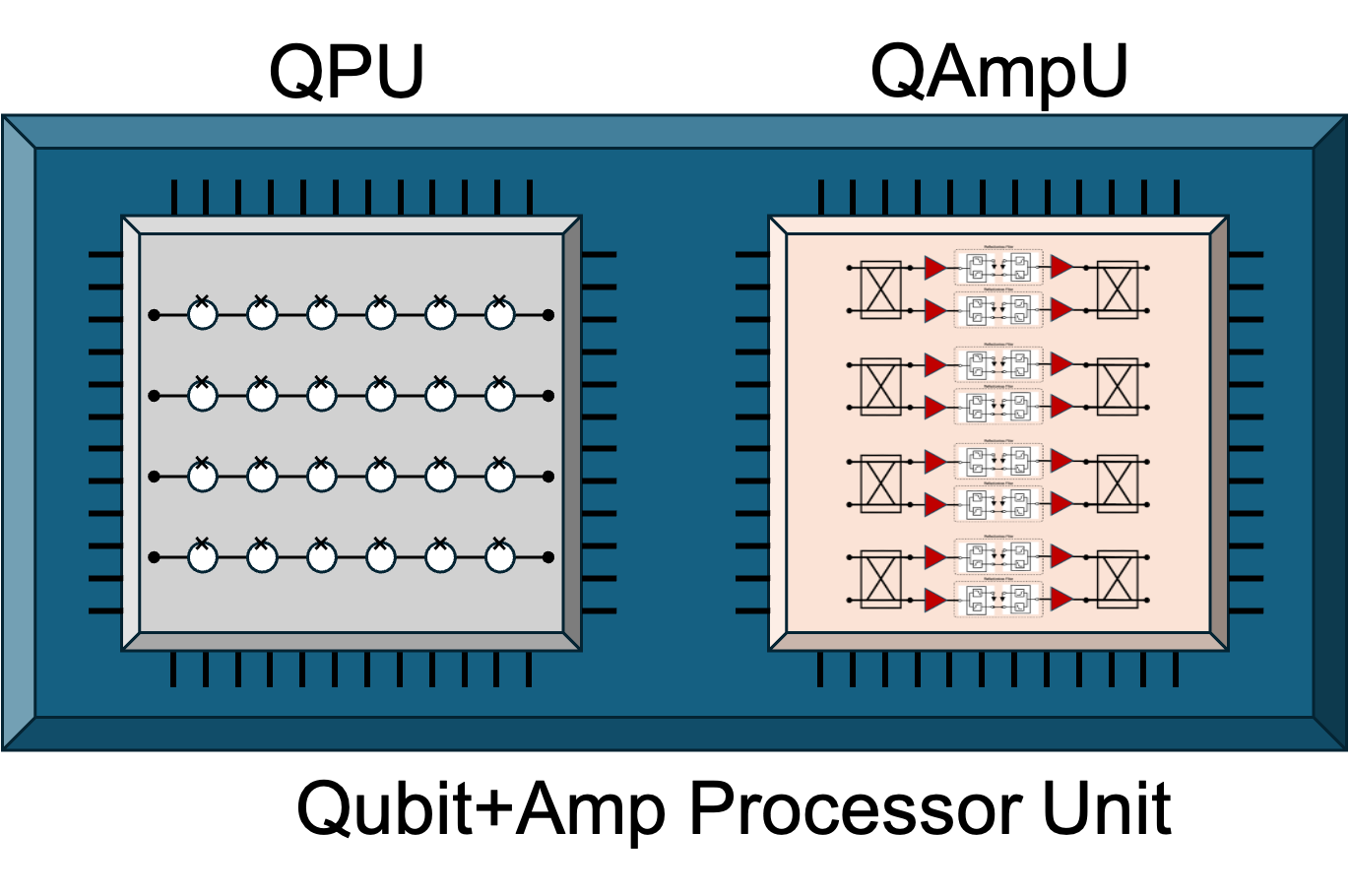
Although substantial global effort has gone into scaling quantum processing units (QPUs) by increasing qubit numbers, progress in scaling the accompanying cryogenic QLA systems has been comparatively slow. This project aims to close that gap. Building on over seven years of QLA research at the University of Oxford, we will develop a new, scalable QLA architecture and demonstrate a modular cryogenic readout prototype capable of supporting 20+ qubits, with a clear roadmap toward systems exceeding 100 qubits.
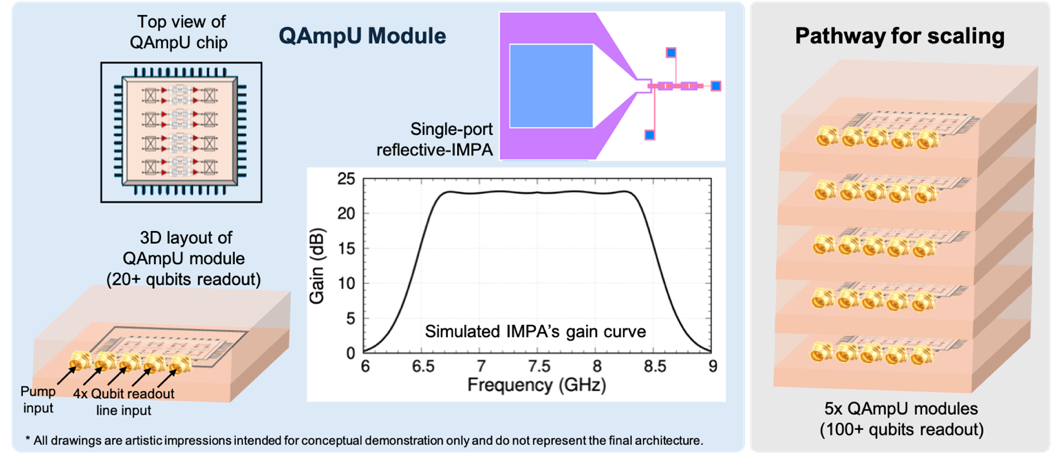
The project will focus on designing and realising an impedance-matched parametric amplifier (IMPA)-based QLA. Current existing QLAs typically require bulky housings and multiple off-chip microwave components, which increase footprint, introduce loss, and ultimately limit scalability. To overcome these challenges, we propose to develop a Quantum Amplifier Array Unit (QAmpU), a compact IMPA-based module that integrates multiple QLA chains with on-chip microwave circuitry for efficient pump and signal coupling, pump rejection, and reverse isolation. Each QLA chain will target the readout of 5–7 qubits, enabling simultaneous readout of 20+ qubits in a minimal footprint.
In parallel, the project will explore advanced packaging strategies for the QAmpU, working closely with mechanical and electrical engineering teams at Oxford. The goal is to produce a robust, modular, and plug-and-play cryogenic unit. Multiple QAmpUs can be integrated within a single cryostat, providing a scalable path to systems with 100+ qubits. Beyond quantum computing, scalable QLA-based microwave readout has wide applications in dark matter searches, satellite communications, as well as astronomical applications from radio to X-ray observations.
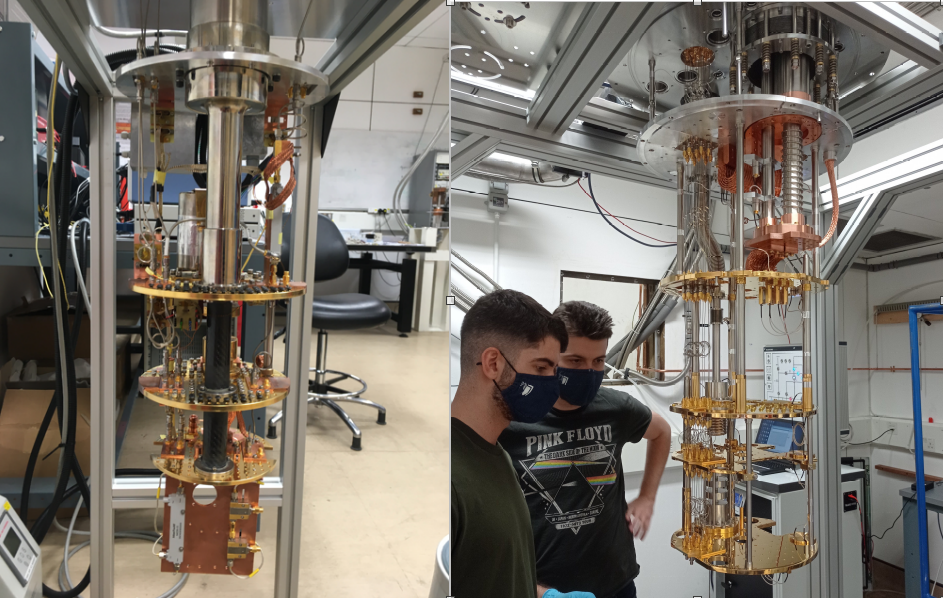
Our laboratory has already established several experimental platforms for testing QLAs at frequencies up to 40 GHz. We are now seeking a motivated DPhil student to join this effort. The project will involve designing and characterising IMPA-based QLAs, developing schemes for signal/pump routing and rejection, achieving reverse-noise isolation in multi-stage chains, and investigating the physics and architecture of multi-QLA chip systems.
This project is an excellent fit for a student who enjoys hands-on instrumentation and experimental physics, from device engineering and cryogenic measurements to data analysis, and who is also enthusiastic about coding, theoretical modelling of quantum sensors, superconducting electromagnetism, and quantum electronics. Working within our state-of-the-art cryogenic quantum detector laboratory, the student will have access to extensive experimental facilities and support from engineers, postdoctoral researchers, and senior DPhil students, as well as a wide range of commercial and custom software tools.
This position is a collaborative studentship between the University of Oxford and the National Quantum Computing Centre. The position will be registered and hosted at the University of Oxford, within the group led by Dr Boon Kok Tan. The student will also have co-supervisors at the NQCC who are experts in the field. Over the course of the studentship, the admitted student will be offered a minimum of three months to work at the NQCC with relevant research teams.
This position is part of a wider cohort of 6 collaborative studentships within the NQCC’s Doctoral Studentship Scheme starting the academic year 2026, where projects have been co-developed by the NQCC and different academic institutes across the UK, including the University of Oxford. The scheme will include cohort-based training and activities, enabling students to gain wider skills and develop valuable personal and professional networks.
Further Readings:
- https://www.nature.com/articles/s41586-022-05434-1.pdf
- https://journals.aps.org/prapplied/abstract/10.1103/PhysRevApplied.21.034055
- https://journals.aps.org/prapplied/pdf/10.1103/PhysRevApplied.20.054058
- https://ieeexplore.ieee.org/stamp/stamp.jsp?tp=&arnumber=10840321