


With the announcement of £2 billion quantum innovation investment earlier this week, the UK government is laying down the gauntlet to the quantum computing industry to accelerate research and development, to bring forward the potential of large-scale quantum computing, driving end-user adoption for early societal benefit and UK economic advantage.
Specifically: “This first-of-its-kind procurement programme, ’ProQure: Scaling UK Quantum Computing’, will launch next week, where companies will be invited to table proposals to partner with us to deliver state-of-the-art prototypes for evaluation.
Prototypes will then be assessed, with the most promising companies invited to deliver larger-scale machines for use by scientists, researchers, the public sector, and businesses, as part of our national computing infrastructure – transforming the UK into a hotbed for the latest, cutting-edge quantum technology.”
Our UK quantum start-ups have raised over £1 billion in private capital to date, and internationally, the levels of investment into quantum tech have surged, with over £10 billion in venture funding raised in 2025 alone. Lord Vallance, UK Science Minister, highlighted on BBC Radio 4 recently that his top priority was anchoring UK quantum startups in the UK and supporting them in their journey to scale and grow. Indeed, UKRI has identified one of its strategic funding priorities as supporting companies to scale and grow. Moreover, how can we attract talent, investment, and business to the UK, given our thriving quantum ecosystem, well-established supply chain, and emerging end-user community? This week marks a pivot point for the UK, where we can look forward confidently to securing high-value employment, first-mover advantage, and the long-sought-after promised impact of quantum technologies.
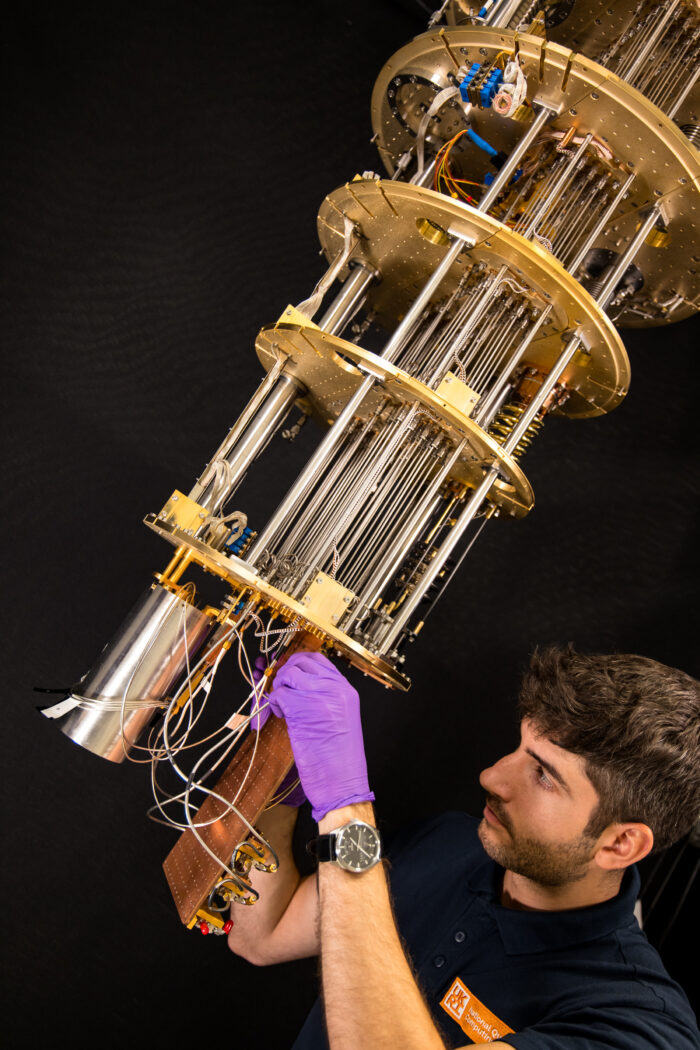
The government has a crucial role to play here, but more than simply footing the bill. Scaling quantum hardware is expensive. By signposting UK ambition, as well as practical interventions such as future procurement, the government is demonstrating its desire both to fuel growth and for government to be a user of the technology – in support of fundamental science, the drive towards Net Zero, improving public services, and for an ever more resilient and secure economy.
Following a decade of global leadership in quantum sensing, imaging, timing, networking, and computing, the UK has a thriving ecosystem and vibrant commercial landscape. By anchoring businesses at scale in the UK, we should expect to see value through intellectual property, high-value jobs, and high-skill manufacturing follow.
Across the breadth of our activities, I see four areas where the NQCC programme maps directly onto the ambitions of the ProQure: Scaling UK Quantum Computing Programme.
Technology road-mapping and collaborative R&D
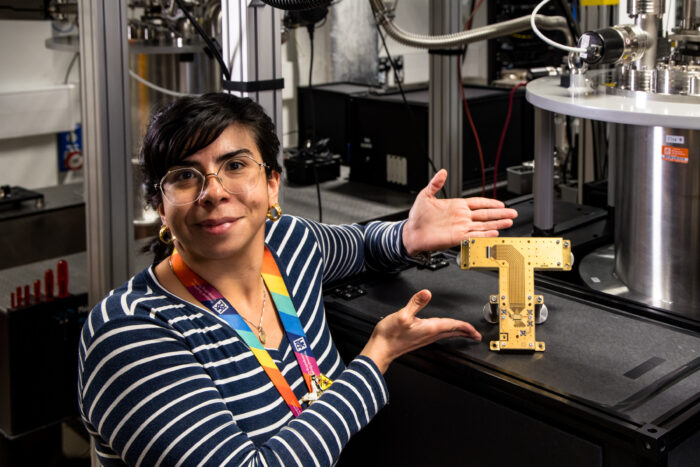
NQCC published its first technical roadmap in 2020 as we launched. This was a cautious framing of the challenges associated with the pathway towards fault-tolerant capabilities ahead and a systematic approach to scaling – not just at the qubit layer but full stack, including control architecture, algorithms, and applications. This approach continues, and as our internal technology programmes have matured, we have incorporated academic and industry input into our blueprints. We see the delivery of these hardware roadmaps as now largely an industry scaling challenge, but recognise there are bottlenecks to collective progress where we, as a National Lab, can convene partners to work collaboratively. Topics such as optical-to-microwave transduction, error correction, readout noise performance, data throughput, and noise modelling are active projects. This road-mapping activity has enabled a framework for the UK to develop, scoping the feasibility and challenge of progress towards our key performance milestones [1]. We now have a robust framework to chart our collective progress, as well as lay out this ambitious forward view through the ProQure endeavour.
[1] Key performance milestones are defined by the scale of computation supported by a state-of-the-art quantum computer as the technology scales. The scale of computation is defined in ‘coherent quantum operations’ labelled as QuOps, and the milestones are to reach 1 million QuOps (MQuOp) by 2030, 1 billion QuOps (GQuOp) by 2033 and 1 trillion QuOps (TQuOp) by 2035.
Benchmarking performance
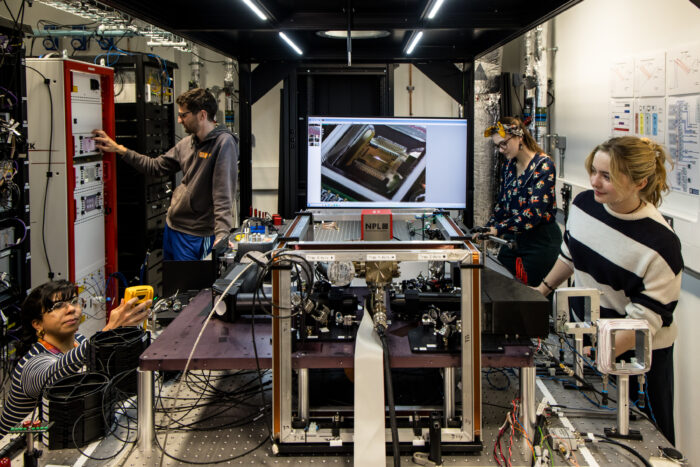
Through the NQCC Testbed Initiative and associated follow-on Technical Test & Evaluation programme, NQCC has both acted as an early customer to our commercial partners and driven assurance on platform performance. By building internal capability, as well as a suite of protocols and benchmarking tools, we are well placed to continue on this pathway of providing independent technical assurance across different modalities as the stages of the ProQure activity progress and as decisions are made to down-select on modalities and providers. Commercial due diligence will play its role, but technical due diligence is vital to support long-term procurement decision-making from a robust and transparent evidence base.
Furthermore, by acting as an anchoring institute on the Harwell Campus, a quantum technologies cluster has developed, with new start-ups joining mature players to form an agglomeration of quantum companies benefiting from a shared outlook for the technology, as well as access to skills and wider capabilities across STFC. More than anchoring companies in the UK, such as our testbed and collaboration partners Quantum Motion, Aegiq, Orca Computing, Riverlane, Nu-Quantum, and Phasecraft, this has catalysed inward investment into the UK quantum ecosystem, with the likes of Rigetti Computing, Infleqtion, and QuEra enhancing their footprint at Harwell as a consequence of this initiative. It is really pleasing to see IonQ extend its commitment to the UK, not only through the Oxford Ionics NQCC testbed platform but also through its research partnership with Cambridge, announced earlier this month.
Delivering value through applications
As the road-mapping for ProQure evolved, indeed from the earliest engagement on how the Quantum Missions would be delivered, the need to drive useful purpose from the technology as it was developed became a clear requirement. The NQCC SparQ Programme has been actively driving industry sector engagement in user adoption, access to QC cloud resources, and sharing best practices through engagement in quantum readiness as an industry challenge. As the technology has developed and the suite of available tools expanded, we have been able to grow our offer to end users. Our portfolio of end users is typically framed in three personas: the quantum curious – eager to learn how quantum computing could impact their business or industry sector; theorists and data scientists looking to add quantum to their toolkit of computational techniques—often very experienced in high-performance classical computing; and finally quantum computing developers – immersed in the subject, developing algorithms and error codes, invariably ‘superusers’. Extending this work to incorporate clear resource estimation and well-defined use cases that map onto strategic economic sectors for the UK, and in support of the drive for societal benefit, sits comfortably within the delivery of SparQ and our wider collaboration with colleagues at the University of Edinburgh Quantum Software Lab.
Skills & workforce development
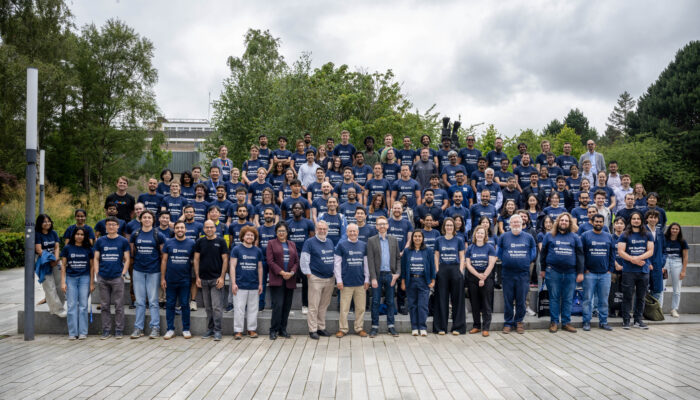
The final area of immediate overlap is the perennial challenge of skills and workforce development. Whether it is growing activities at the NQCC or scaling our companies in the UK, we all need talented people to deliver our programmes. Over the next 20 years, quantum computing should drive a 7% increase in productivity and create more than 100,000 jobs. Today, we have approximately 3,000 quantum workforce across government, industry and academia. Doctoral Training Centres alone will not produce the talent needed – indeed, our future quantum workforce is not solely the domain of PhD physicists. We need engineers, technical sales & marketing professionals, systems architects, software developers, data scientists, application specialists, domain champions and more. Through activities such as the annual NQCC Hackathon, our self-directed web training toolkit, and deep-dive quantum information science immersive courses, in partnership with the University of Bristol, we are supporting the drive for continuous professional development and specific domain expertise, supporting our growing quantum sector.
Building on £1 bn investment across the NQTP since 2014 in skills, research, and commercialisation of quantum technologies, the UK is doubling down on this commitment to a further £1bn over the coming four years, driving quantum at scale, with a future £1 bn of advanced market commitment to procure large-scale quantum computing platforms capable of delivering a billion quantum operations by 2031. I am thrilled the NQCC is so well placed to deliver technology across the stack and to fulfil this renewed ambition.