


The latest article from the NQCC’s Trapped-Ions team describes how their laser system design shifts the burden of laser light delivery from a time-consuming task towards the procurement of a stand-alone product.

Figure 1: NQCC’s Ion-trap researchers.
Lasers in atomic physics
Atom-based systems are among the most promising approaches to scalable quantum computing. The control and delivery of laser light forms a major sub-system of these platforms, with laser trapping, cooling, and coherent control key to their operation. Laser system performance translates directly into key performance metrics of the overall system. In addition, it is important to consider practical requirements, such as footprint, cost, reproducibility, and ease-of-use. As these technologies move towards product-like deployment, a scalable, modular solution to laser systems is required.
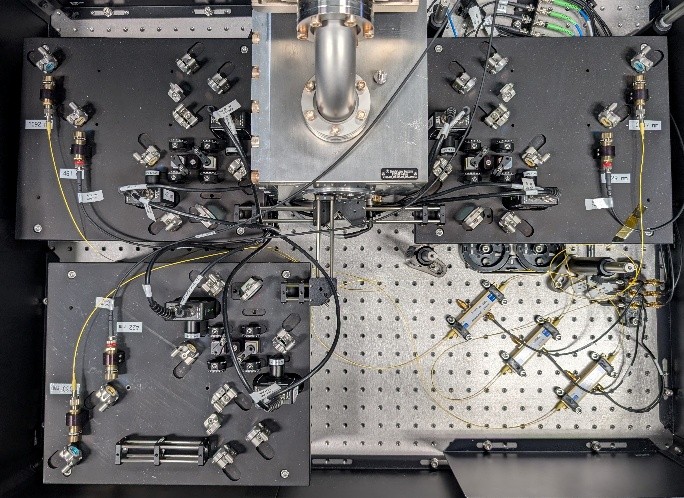
Figure 2: A complete locking station. Three cavity board modules surround the reference cavity. This setup stabilises six different wavelengths independently.
Our concept
Our work describes laser systems consisting of flexible high-performance modules. We demonstrate their performance by characterising key metrics and by integration with ion trap systems. At its core are custom optical boards that significantly reduce the number of components and alignment degrees of freedom. Our approach shifts the setup burden away from the end user to the design and manufacture of the boards. The resulting systems are significantly cheaper, more compact, and faster to assemble.
As quantum technologies move towards product-like deployment, modular approaches become an integral part of scaling systems, as it means that parts can be upgraded or replaced with minimal disruption to the overall platform.
Our modules
Each module is a custom-machined board with accurate positioning of optics using dowel pins. Our modules reduce the number of degrees of freedom by approximately 70%, increasing precision and reproducibility and reducing the time required for alignment. The boards minimise the footprint of the system with increased mechanical stability due to the reduction in components.
Each module’s function is a common requirement across atomic physics. These can then be combined flexibly to meet system requirements.
Distribution Module: Splits laser light from a single input into six variable outputs.
Acousto-optical Modulator (AOM) Module: Allows for control of the frequency and amplitude of an individual laser beam.
Dichroic Combination Module: Overlaps a pair of laser beams and injects them into the same optical fibre.
Cavity Module: Aligns laser light to a reference cavity and generates a Pound-Drever-Hall (PDH) error signal for laser stabilisation.
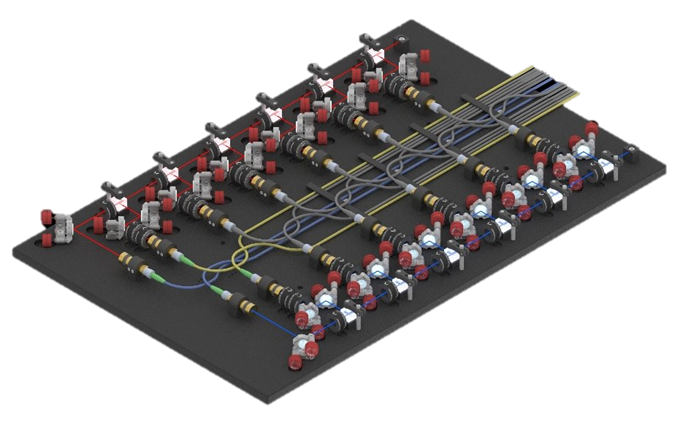
Figure 3: Rendering of a laser system module.
Performance
Three instances of this laser system have been delivered. The performance has been verified across a range of 13 wavelengths spanning a spectrum from 375 nm to 1092 nm.
Robust operation is a key requirement of any product. Long-term stability has been observed over several months. The system has been transported between two labs 100 miles apart with minimal realignment required to recover the specified performance.
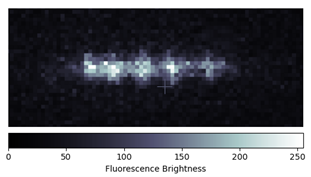
Figure 4: Chain of 5 88Sr+ ions trapped with our modular laser system.
The performance was further characterised by several key metrics: frequency stability with linewidths <500 kHz, polarization extinction ratios >40 dB, overall power delivery (from laser source to experimental output) >21%, free-running power deviation <1 %, and frequency tuning > ±50 MHz.
Design availability and licensing
The designs are available for licensing, and we welcome inquiries from potential partners. Please contact STFC Business & Innovation for further information.
Read pre-print here.