

2025 marks the United Nations’ International Year of Quantum Science and Technology (IYQ), celebrating 100 years of quantum mechanics. IYQ makes as one of its central recommendations the application of quantum science and technology for sustainable development. At the NQCC, we’re committed to embedding and championing sustainability throughout our work. As we approach the IYQ Closing Ceremony in February 2026, this blog reflects on our current approaches and future plans, bringing together perspectives from across our teams on the ways we incorporate sustainability throughout our efforts to enable the development and adoption of quantum computing.
Understanding the energy consumption of quantum computing
Jonathan Burnett, Deputy Director for Research
In general, technology exists to be beneficial for society, and this usually comes with associated energy costs. During the winter season, it is likely that many of us will make use of heater technology to keep warm. The maximum output of an electric heater is approximately three kilowatts. Another technology we often use is computing, where a power-efficient laptop might run on just 100 watts. However, computing can take many forms. At large scale, so-called supercomputers routinely operate at tens of thousands of kilowatts. When assessing this usage, we often need to distinguish between different parts of the process and how much power is consumed. For example, when considering the energy consumption of artificial intelligence, we distinguish between the training phase and serving phase. The training phase might involve hours or days of running at megawatts of power. However, when responding to queries, the serving phase might be fractions of a second and therefore consume much less power.
For quantum computing, the hope is that it will be capable of solving challenges that aren’t possible with a classical computer. In 2019, Google AI demonstrated a specific use case that required a quantum computer to operate for 200 seconds at 26 kilowatts. The equivalent classical task on a supercomputer required over an hour of runtime at 5.73 megawatts. While this use case targeted a problem that quantum computers should be better suited to than classical computers, it did nonetheless demonstrate that quantum computing could be significantly more energy efficient for particular problems. Across the next decade, we hope to see quantum computers become better performing and therefore find increasingly useful applications.
At present, there is limited data on power consumption across quantum computing architectures. Here, the methodology needs to be developed. The Google AI example above considers something analogous to the serving phase in an AI response, but not the equivalent of the training phase, meaning we do not have information on the energy consumption during the building, commissioning and set-up of quantum computers. To make progress across these frontiers, NQCC will have a PhD student starting this year working on developing the methodology, increasing transparency of consumption and providing an evidence base to inform future quantum computing design decisions.
Sustainable approaches to High Performance Computing for quantum computing
James Thorne, HPC/IT Systems Manager
At the NQCC we rely on High Performance Computing (HPC) for a range of applications, but it comes at a cost. Compute clusters consume a lot of energy and as demand grows, so does the environmental impact. The challenge is balancing the cost with the benefit of the research. The good news? HPC is evolving to become more sustainable through innovative strategies that reduce carbon emissions and make better use of resources.
One promising approach is carbon-aware scheduling. Instead of running HPC jobs as soon as resources are available, schedulers can optimise for periods when the electricity grid is greener. For example, during periods of high renewable generation, such as sunny or windy conditions, the carbon intensity of the grid drops. By aligning compute workloads with these windows, HPC systems can dramatically reduce their carbon footprint without sacrificing performance. This is where the National Energy System Operator’s Carbon Intensity API comes into play. It provides real-time and forecasted data on the carbon intensity of electricity in the UK. HPC schedulers can integrate this API to make intelligent decisions, delaying non-urgent jobs until cleaner energy is available. It is a simple yet powerful way to make HPC operations more climate-friendly.
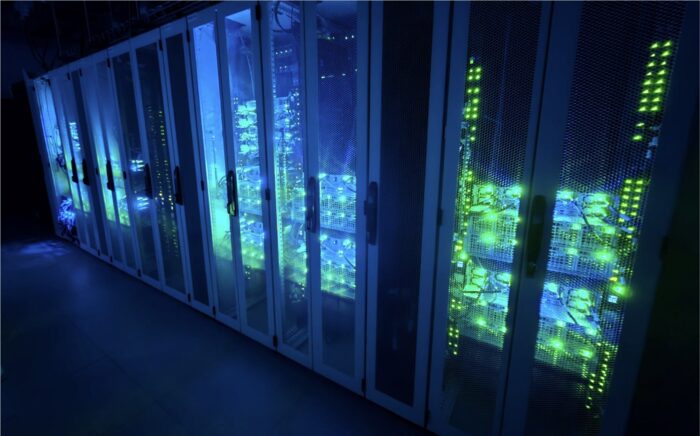
Another sustainability challenge is heat. HPC generates a lot of it, as much of the energy consumed by HPC is eventually converted into heat. In addition, cooling systems often consume additional energy to keep temperatures in check. We are capturing and redirecting waste heat from compute nodes to heat NQCC offices and labs. This approach reduces heating costs and improves overall energy efficiency.
Building sustainable facilities
Chris Pulker, Facilities Manager
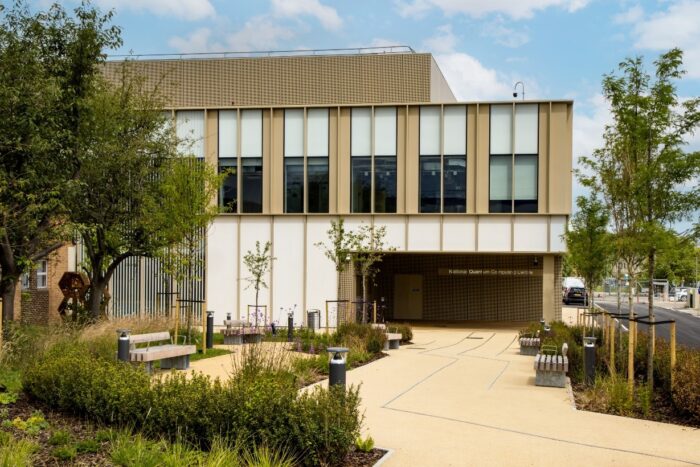
At the NQCC, sustainability is embedded in the way we design, operate, and continually improve our facilities. Quantum technologies rely on highly controlled environments: cryogenic systems, precision lasers, and vibration‑isolated laboratories all require substantial energy, so understanding and managing our resource use is essential.
Our approach began more than five years ago, when we worked closely with construction industry experts to define the building services needed for a national‑scale quantum facility. Sustainability, flexibility, and resilience were central to that brief. We set out to adopt cutting‑edge systems that could support world‑leading science while minimising environmental impact.
The building’s heating and cooling infrastructure is based on high‑efficiency heat pumps with heat recovery. This allows us not only to reduce overall energy consumption but also to reuse heat generated by cooling laboratory spaces to warm other parts of the building. Ventilation systems follow the same principle: they incorporate high‑efficiency heat recovery and continuously monitor air quality in each area, adjusting airflow in real time to maintain optimal conditions with minimal energy use.
Natural daylight is maximised throughout the building to reduce reliance on artificial lighting, while our power distribution uses high‑efficiency transformers, LED lighting, and modern electrical systems designed to minimise losses. These choices reduce both energy use and the long‑term maintenance burden, extending equipment life and lowering the facility’s overall carbon footprint across its full lifecycle. Solar panels installed on the roof further increase our on‑site renewable energy generation.
All building systems are coordinated through an advanced Building Energy Management System (BEMS) with AI‑driven optimisation. The BEMS continuously monitors and analyses performance, enabling us to fine‑tune operations and respond quickly to changes in demand. Alongside this, we track electricity, heating, cooling, and water consumption across the site, giving us a detailed understanding of how our laboratories and support spaces behave throughout the day. These insights help us identify opportunities to improve efficiency—from refining HVAC performance to reducing idle loads in specialist equipment.
Sustainability in a national research facility is an ongoing journey. Through careful measurement, thoughtful design, and a commitment to continuous improvement, we aim to ensure that the NQCC’s infrastructure supports world‑class quantum research while contributing meaningfully to the UK’s wider environmental goals.
Use cases for sustainable development
Mariana Manso, Quantum Innovation Sector Lead
At the NQCC, we focus on developing practical applications of quantum computing across a broad and diverse portfolio. Through our SparQ programme, we collaborate with industry and academic partners to identify and advance quantum use cases in areas such as renewable energy, healthcare, pharmaceuticals, advanced materials, logistics, and more, driving innovation and demonstrating the potential of quantum computing.
One example is our collaboration with Frazer Nash Consultancy on renewable energy systems, where we explored how quantum computing and quantum-enabled optimisation could help address complex challenges in the sector, such as spatial and resource planning for offshore wind. At the same time, we are investigating quantum-enabled simulations in healthcare and pharmaceuticals to accelerate drug discovery and improve the design of effective therapies.
These projects represent just part of our growing portfolio. Together, they highlight how quantum computing can deliver technological innovation with tangible impacts across a range of sectors.
Highlighting SDG use cases at the 2025 UK Quantum Hackathon
Natasha Oughton, Quantum Computing Policy and Ethics Lead
In recognition of the International Year of Quantum, the 2025 UK Quantum Hackathon highlighted use cases offering societal benefit, and in particular those aligned with the UN’s Sustainable Development Goals (SDGs). Of the final use cases selected, many were strongly aligned with one or more of the goals.
For example, a BT use case sought to enable proportional and fair frequency packet scheduling for mobile networks, aligning with SDG 9 (Industry, Innovation and Infrastructure) and SDG 10 (Reduced Inequalities).
A use case from Applied Quantum Computing aimed to utilise quantum machine learning for diabetes identification, supporting SDG 3 (Good Health and Well-Being).
A use case from Moonbility aimed to utilise quantum computing to generate barrier-free navigation routes for mobility-impaired users in urban transit systems. In doing so, the use case supports SDG 11 (Sustainable Cities and Communities), SDG 10 (Reduced Inequalities), and SDG 9 (Industry, Innovation and Infrastructure).
Through this focus on sustainable development at the NQCC’s hackathon, we aim to showcase the potential of quantum computing in applications for societal benefit, and enable and encourage future work in this important area of development.